
Kevin Becerra, K, V Plaza, L Castillo & L Godoy (2025) Cell wall modifications in Saccharomyces cerevisiae wine
yeast through adaptive laboratory evolution with Tebuconazole. Scientific Reports 15:25438
Archivos de la categoría: Noticias
Hernandez-Cabello et al. (2025)
Hernandez-Cabello, L.; Rojas-Torres, N.; Godoy, L.; G-Poblete, C.; Concha, Y.; Plaza, V.; Castillo, L.; Mora-Montes, H.M.; Ganga, M.A. Step-Wise Ethanol (2025) Adaptation Drives Cell-Wall Remodeling and ROM2/KNR4 Activation in Brettanomyces bruxellensis. Microorganisms 13:1489.
González-Salinas et al. (2025)
González-Salinas, Ch, B.R. Broitman P.A. Haye & N.I. Segovia (2025) First evidence of fine-scale adaptive genetic structure in farmed populations of Mytilus mussels. Aquaculture 609: 742817 1-11
Chávez-Villavicencio et al. (2025)
Chávez-Villavicencio, C. & M. Rivadeneira (2026) Range contraction and increasing extinctionrisk projected for climate scenarios for the lizard Liolaemus maldonadae Núñez et al., 1991 (Squamata, Liolaemidae) in northern Chile. South American Journal of Herpetology, 34: 42−49
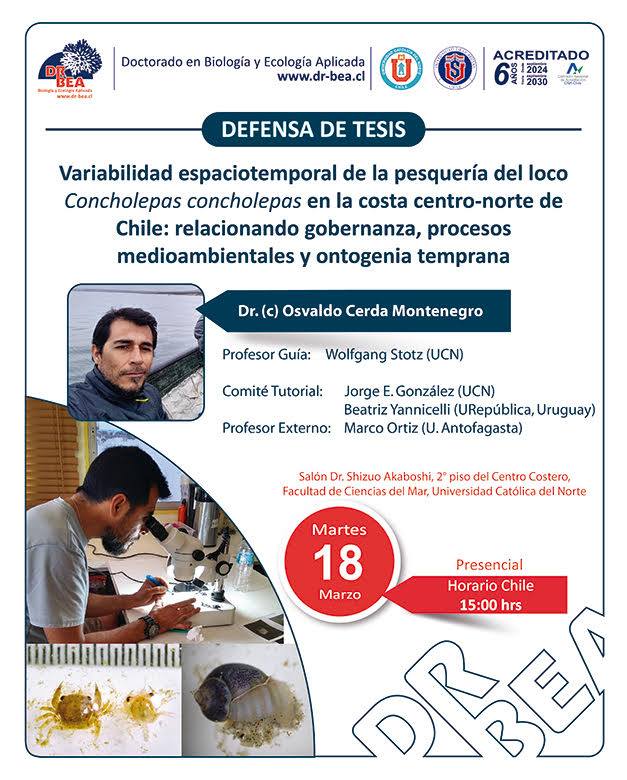
Wallberg et al. (2025)
Wallberg, B,N., J. Pizarro-Araya, F.M. Alfaro, J.E. Calderon & A.P. Loayza (2025) Age-driven structural characteristics relate to epigeal arthropod communities in olive agroecosystems of the Atacama Desert. Agriculture, Ecosystems and Environment 385: 109593. https://doi.org/10.1016/j.agee.2025.109593
Abstract
Intensive agriculture has led to a significant global decline of biodiversity. However, agroecosystems like olive groves can serve as biodiversity refuges, especially in arid environments, by acting as resource islands that promote the persistence of multiple species, including arthropods. The structural complexity and productivity of olive groves typically increase with age, enhancing their ability to sustain high biodiversity. In this study, we examined how epigeal arthropod diversity patterns vary across olive orchards of different ages in the Huasco Valley of Chile’s Atacama Desert. We hypothesized that older olive orchards, with greater structural complexity and productivity, would harbor higher arthropod abundance, diversity, and distinct community compositions than a younger olive orchard. To test this hypothesis, we sampled epigeal arthropods in three olive orchards of different ages (young, intermediate, and centennial) using pitfall traps and characterized each orchard’s structure and productivity (NDVI). Our findings indicate that olive orchard age is related to arthropod composition and abundance but not diversity. Young and intermediate olive orchards had higher arthropod abundance, dominated by isopods and hymenopterans, while entomophthorans and mites predominated in the centennial orchard. Each orchard harbored a unique arthropod community, with NDVI being a key factor in the centennial orchard, dry weed biomass in intermediate orchards, and leaf litter in young groves. These results suggest that the structural characteristics associated with olive orchard age play a crucial role in shaping arthropod communities in arid environments, highlighting the importance of habitat management within groecosystems for promoting biodiversity.
Plaza et al. (2025)
Plaza, V.; Pasten, A.; López-Ramírez, L.A.; Mora-Montes, H.M.; Rubio-Astudillo, J.; Silva-Moreno, E.; Castillo, L. Botrytis cinerea PMT4 Is Involved in O-Glycosylation, Cell Wall Organization, Membrane Integrity, and Virulence. J. Fungi 11:71.